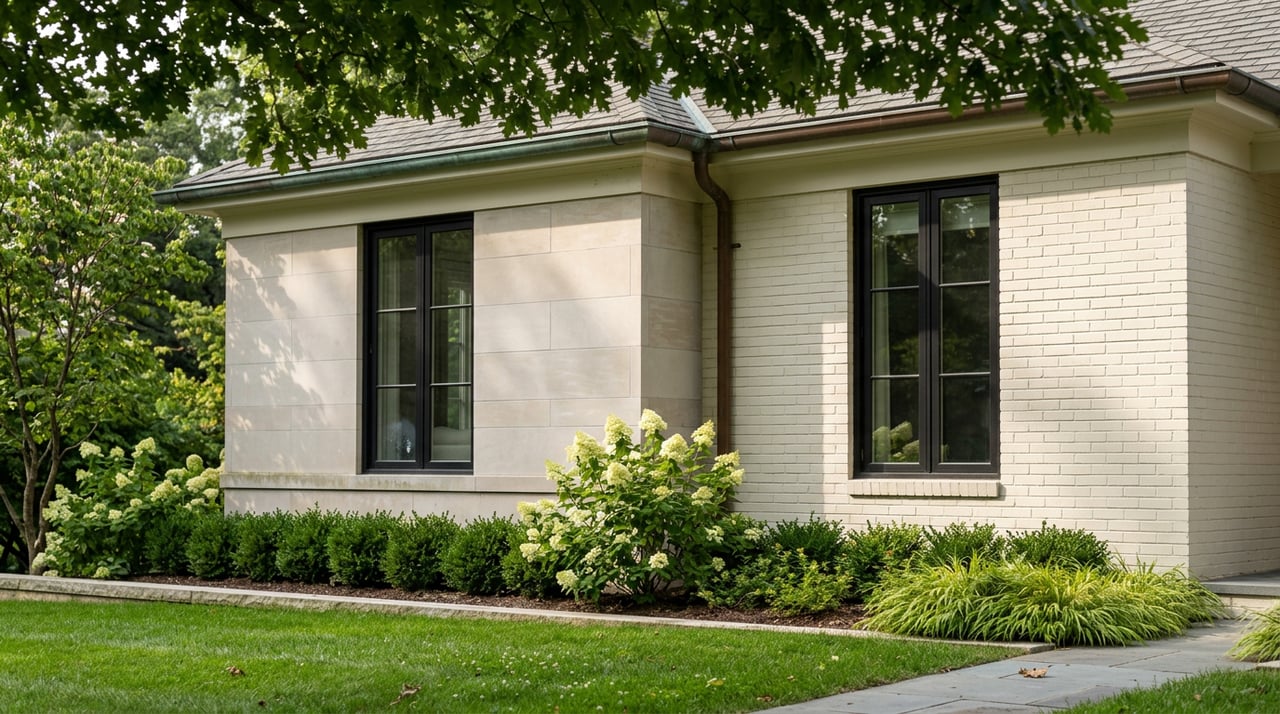
Open the portals and Town and Country looks softer than its reputation. Movoto put the median list price at $873,000 in June 2026, with homes sitting a median of 145 days. Homes.com pegged the trailing twelve-month median sale near $829,000. Zillow's ZHVI, updated May 31, 2026, showed the average home value at $1,180,153, up 6.0% year over year.
Those numbers are all correct, and read together they mislead. The entry tier in Town and Country is not priced as a house. It is priced as a permitted acre with a structure the next owner will probably remove. Once you accept that framing, everything else about the market, from the flat ranches lingering on market to the $3M new builds a block away, starts to line up.
Read the acre, not the house
Town and Country's zoning holds lots to a one-acre minimum, and the city does not annex or absorb new subdivisions. Supply is fixed by geometry. That is why a well-maintained but dated home on a one-acre lot enters the market between roughly $800,000 and $1.1 million, while an updated home with contemporary finishes clears the $1.5M to $3M band, and architect-designed custom builds on two-plus acres routinely trade above $4M, with several $8–12M sales in recent years.
The clue hiding in the portal data is price per square foot. Movoto's June 2026 figure was $474 per square foot in a market where the same source reported a median list under $900,000. That is a land number wearing a house number's clothes. Two homes with identical square footage in Town and Country can vary by $400,000 or more depending on lot size, mature canopy, and whether the parcel picks up creek frontage. What the buyer is paying for is the dirt, the trees, and the right to control the borders. The structure is a placeholder.
That framing changes the question at the offer table. It is not "is this house worth $950,000?" It is "is this acre, minus demolition, worth $950,000 to me?"
The renovation-versus-rebuild fork
Once the entry-tier buyer accepts that the existing home is optional, two paths open. Whole-home renovation typically runs 40% to 60% less than teardown-and-rebuild for a comparable finished result, according to Aleto Construction Group's Town and Country practice. Renovation also preserves things a new build has to rebuild from scratch: mature landscaping, established grading and drainage, existing hardscape, and the position of the house on the lot. Teardown-and-rebuild has been the dominant development pattern in the city for the past decade, with new construction leaning transitional-to-contemporary, open plans, main-level primary suites, and outsized outdoor-living budgets.
Here is the choice framed as a spreadsheet the buyer should be running before the offer, not after inspection:
| Path | What you keep | What you spend | Best when |
|---|---|---|---|
| Renovate | Trees, grading, driveway, footprint, foundation | ~40–60% less than a rebuild for comparable finish | Structure is sound and floor plan is workable |
| Teardown and rebuild | The acre and the address | Full custom build cost plus demolition | Foundation, framing, or moisture issues, or plan is unfixable |
| Buy already updated | Time, timeline risk, ARB queue | $1.5M–$3M list price | You want to move in this year |
The $400,000-plus swing that lot quality alone can produce means the renovation-vs-rebuild math should be run before choosing which listing to pursue, not after. A larger lot with a mediocre house may pencil better than a smaller lot with a good house, once the renovation budget is applied.
The Architectural Review Board is the ceiling
The friction that shapes the timeline for either path is the Architectural Review Board. Its role is not decorative. Every new residence, every front-of-house addition, every addition over 500 square feet, every subdivision gate, and every non-street-facing roof-mounted solar array must go before the ARB before the city will issue a permit. The board meets monthly, first Monday at 5:30 p.m. Applications carry a $350 fee, require twelve collated packet sets submitted ten days before the meeting, and trigger written notification by first-class mail to every property owner within 300 feet of the proposed lot line. On residential applications, the ARB's decision is final except as narrowly provided in Section 500.115(F) of the municipal code.
For a buyer who intends to rebuild, three consequences follow. First, the calendar is monthly, not weekly, so a missed submittal deadline is a missed month. Second, the 300-foot notice means your future neighbors are formally informed before you own the lot, and they can appear at the meeting. Third, the ARB rewards representation. Builders who present regularly, know the board members, and bring physical exterior-material samples move faster than one-off applicants. Ask any candidate builder how many ARB approvals they closed in the last twelve months. The answer is a proxy for how many months your project will sit in queue.
The entry-tier listing is a land deal with a demolition allowance and an ARB calendar attached. Price it that way.
Where the current pipeline actually sits
If you want to see what an approved rebuild looks like today, the active projects are legible on the map. Kemp Signature Homes is delivering the Nottingham II Ranch at roughly 5,200 finished square feet and the Hawthorne I at over 6,300 square feet on 1.98 acres in the Ballas Ridge enclave. McBride Homes is bringing an upscale condominium product to Woods Mill Crossing near Highway 141 and 40, with Willow-floorplan units delivering in fall and winter 2026, a rare Town and Country condo option in a market otherwise dominated by single-family estates. Mosby Building Arts shows up frequently in the interiors of the higher-tier resales.
The subdivisions where the teardown-and-rebuild pattern is most visible include Topping Woods Estates, Arlington Oaks, Manderleigh, Stonechase on Conway, Thornhill Estates, Los Arroyos, and the Bellerive Country Club Grounds, which had a new house on the ARB agenda earlier this year. If your search is anchored in one of these subdivisions, comparable-sale analysis needs to separate the finished-new-build comps from the dated-original comps. Averaging them together produces a number that describes neither.
Migration signal worth naming
Redfin's Q4 2025 search data showed 65% of Town and Country searchers staying inside the St. Louis metro, with inbound out-of-metro interest led by Los Angeles, Washington, and New York. Combined with the observation that many new-construction buyers here are downsizing from even larger estates already inside the city, the picture is less "relocation destination" and more "internal reshuffling." That is why 6% annual appreciation coexists with a 145-day median time on market. Scarcity does not create bidding wars in this market. It creates patience.
What to do with this before you write an offer
- Ask the listing agent for the last five comparable sales inside the same subdivision and separate them into original-condition versus rebuilt or fully renovated. Median the two groups separately.
- Get a demolition bid and a renovation feasibility scope in parallel during your inspection period. The 40–60% delta is a range, not a rule.
- Confirm the setback, height, and coverage envelope your target lot allows under the current code before you assume you can rebuild the plan you want.
- Time your rebuild schedule off the first-Monday ARB calendar. Build in one buffer month for a resubmit.
- Interview two builders on their ARB track record, not their portfolio.
Frequently asked
Is a Town and Country teardown treated as new construction for property-tax purposes? St. Louis County reassesses on the improved value after completion. Your assessment will step up meaningfully once the new structure is on record. Confirm the current year's assessed value at the county before you model carrying costs.
Can I skip the ARB if I only remodel the interior? Interior-only work does not require ARB approval. Any addition over 500 square feet, any front-of-house change, and any new principal building does.
Do the ARB neighbors actually show up? On uncontroversial submissions, rarely. On projects that change sightlines, tree canopy, or subdivision character, yes. The 300-foot notice is designed to bring them in.
If you are weighing a Town and Country lot and want a read on whether the acre pencils as a renovation, a rebuild, or an already-updated purchase, that is the kind of comparable-sale work our team runs before you write the offer. Reach out to Show + Sell STL and we will walk the numbers, the ARB calendar, and the subdivision comps with you. Get Your Free Home Valuation to start the conversation.